
Real-life guide
Eczema in perimenopause and menopause: why it flares and what helps
At a glance
If dry, itchy, red or scaly patches have appeared or got worse in your 40s, 50s or later, eczema is one of the likely explanations. Menopause is not a proven cause of eczema, but the skin changes that come with it can make eczema-type rashes more likely, and a flare can look a lot like ordinary dry itch. Start with gentle washing and a plain, fragrance-free moisturizer. See a pharmacist or doctor if the rash is red, cracked or weeping, keeps coming back, or does not improve with gentle care.
This guide helps you sort out which of three things you may be dealing with: eczema, dry-skin itch, or a reaction to something touching your skin. For itch without a clear rash, see why menopause makes skin itch.
Key points
- The NHS lists “skin changes, including dry and itchy skin” as a menopause symptom. Its list does not mention eczema (NHS).
- In one large study of perimenopausal and postmenopausal women, eczema-type rashes were among the most commonly reported skin problems (review).
- Eczema, dry-skin eczema and contact dermatitis can look alike. A clinician can tell them apart, and the first steps are similar.
- Eczema that looks infected needs urgent attention (see below).
Can perimenopause or menopause cause or worsen eczema?
It may play a part, but menopause is not a proven cause. A 2022 dermatology review cites a large observational study in which eczematous eruptions, including allergic contact dermatitis and asteatotic eczema, were the most commonly reported dermatoses in perimenopausal and postmenopausal women.
The review offers a possible reason. It links dermatitis to loss of skin barrier function, with more water escaping through the skin, and says it is possible that low estrogen contributes. This is a suggestion, and the authors say more research is needed.
DermNet adds that estrogen helps maintain skin hydration and the production of ceramides, sebum and hyaluronic acid. Drier skin is easier to irritate.
The NHS lists other triggers for atopic eczema: soap, washing detergent, pets, heat or changes in temperature, stress, and hormonal changes such as those in pregnancy. Triggers differ from person to person, and the National Eczema Association says rarely is just one trigger responsible for every flare.
Is it eczema, dry skin or contact dermatitis?
You cannot reliably tell by looking, and a diagnosis needs a clinician. These are the usual differences.
Ordinary menopausal dry itch. Skin feels tight, rough or itchy, often with little visible rash. The AAD says skin holds water less well after menopause. Our guide to why skin gets dry after menopause explains the change.
Eczema (atopic eczema). The NHS describes skin that is dry, cracked, crusty, scaly or thickened, with flare-ups and better times. The National Eczema Association says eczema almost always includes itchy skin. A rash that looks like eczema but has never happened to you before is worth having checked.
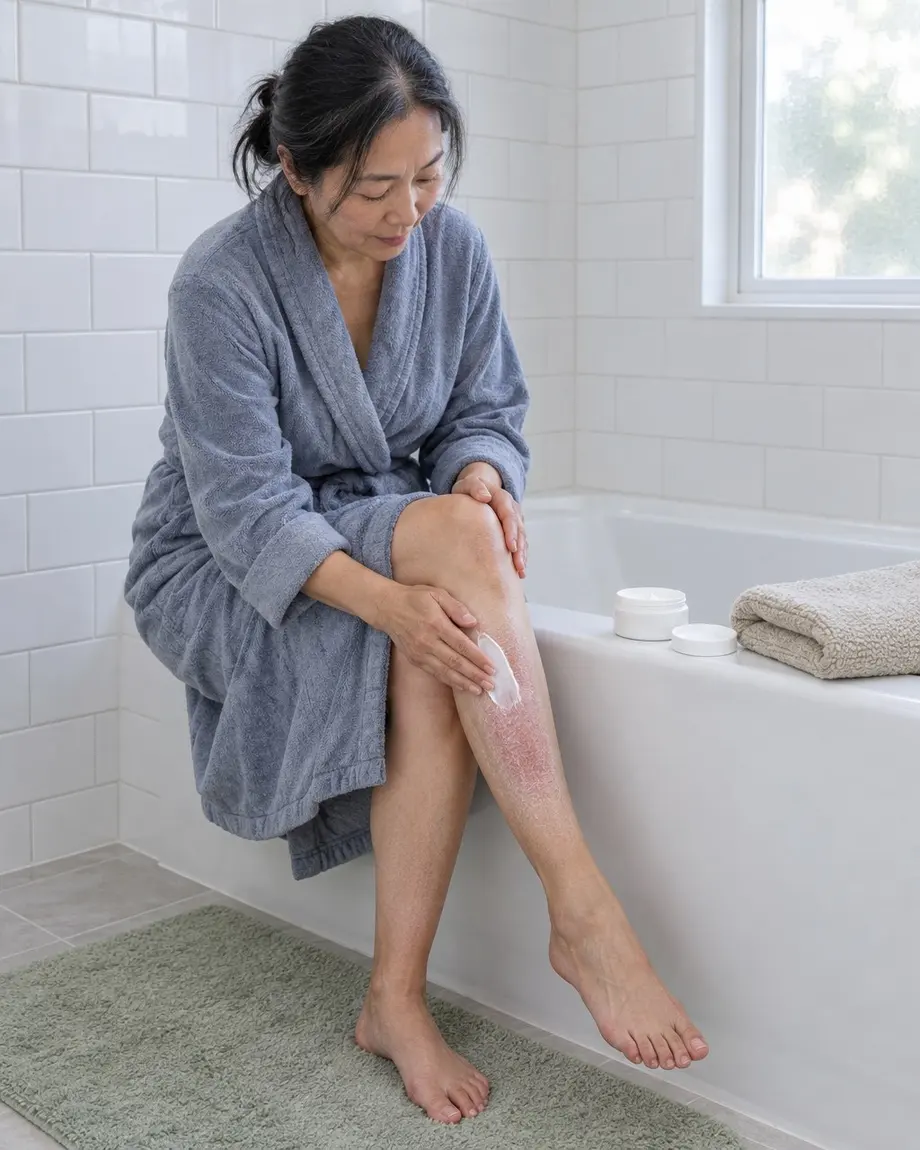
Asteatotic eczema. DermNet says this can occur in anyone with very dry skin and most often affects older people. It describes a “crazy-paving” look, with diamond-shaped plates of skin separated by red bands, most often on the shins. It names dry air, winter heating and excessive bathing with soaps and detergents as triggers, and says it usually responds rapidly to treatment but is very likely to come back. DermNet’s menopause page describes it as the end result of increased skin dryness.
Contact dermatitis. The NHS says this is a reaction to something touching the skin. It causes itchy, blistered, dry and cracked skin within hours or days of contact. Irritant contact dermatitis is the more common type, usually from soaps, detergents, solvents or regular contact with water. Allergic contact dermatitis is less common and can be triggered by products such as cosmetics, or by metals like nickel.
A rash that clearly follows a new product or a new cleaning task points toward contact dermatitis. For burning, stinging or red patches that may be something else, see menopause skin rash, red patches or burning.
Where eczema shows up
- Hands. The NHS says atopic eczema is common on the elbows, knees and hands. Contact dermatitis most commonly affects the hands and face. Frequent handwashing and regular contact with water are classic irritants.
- Shins and lower legs. This is the most common site for asteatotic eczema (DermNet). If your legs are rough as well as itchy, see our urea lotions for dry rough legs and arms.
- Face. The face is a common site for contact dermatitis. The NHS says to check the ingredients of make-up and soap if you think a product is the cause.
- Scalp. An itchy, flaky scalp has its own causes. See itchy scalp in perimenopause.
Does HRT help or trigger eczema?
The evidence is thin. DermNet says menopausal hormone therapy may offer improvement to adverse effects of menopause on the skin and hair, but that is a general statement about skin changes, not a finding about eczema.
The 2022 review reports no trial of HRT for eczema. It notes only that transdermal estrogen has been shown to reduce water loss through the skin. There is no established evidence that HRT triggers eczema either.
So HRT is not an established eczema treatment. If you are considering HRT for hot flushes or other symptoms, mention your eczema to the prescriber and watch how your skin responds. That decision is between you and your clinician.
What helps day to day
The same basics apply whether the cause is eczema, dry skin or irritation. They manage the skin. They do not cure eczema.
- Moisturize every day, often. The NHS says to apply emollients as often as possible, at least 2 times a day. Smooth them on gently, in the direction your hair grows (NHS emollients).
- Moisturize right after washing. The NHS says to apply an emollient as soon as you have patted your skin dry. The National Eczema Association says within 3 minutes of bathing or showering.
- Keep water short and warm, not hot. The AAD advises baths and showers of 5 to 10 minutes in warm water. The NHS says being hot can make eczema more itchy.
- Use a soap substitute. The NHS suggests washing with an emollient instead of soap, and says not to use aqueous cream because it can irritate the skin and make eczema worse. Our body wash picks for dry, itchy menopausal skin cover gentle options.
- Choose fragrance-free. The National Eczema Association says to choose fragrance-free moisturizers and lists fragrance among common triggers. See fragrance-free and unscented products.
- Mind fabrics and detergents. The National Eczema Association lists wool, latex and synthetic fabrics among common triggers, and the NHS lists some fabrics and washing detergent.
- Protect your hands. The NHS suggests gloves for contact dermatitis, taken off now and then because sweating can make symptoms worse (NHS).
- Do not scratch if you can help it. Press or pat the area, or hold something cool on it, instead.
Ointments and creams hold in more moisture than lotions, according to the National Eczema Association and the AAD. If your skin is mainly dry and itchy, our moisturizers for perimenopause itchy skin and first steps for dry skin are the next stop.
Emollients are a fire risk. The NHS says to keep away from fire, flames and cigarettes when using them, and that fabrics that have touched an emollient can catch fire easily.
When is treatment needed?
Moisturizing is the base. If the skin stays red, inflamed or very itchy, you may need a medicine as well. The NHS describes steroid creams, lotions or gels (topical corticosteroids) as a treatment for eczema, and says a GP can prescribe some treatments or refer you to a skin specialist. It says a pharmacist can give advice and recommend some treatments for small areas of eczema that are dry and slightly itchy.
Which treatment, how strong and for how long is a clinician’s decision. Use only what you are given, as directed.
When to see a doctor
See a GP or pharmacist if:
- treatments are not helping your eczema (NHS);
- contact dermatitis symptoms are persistent, recurrent or severe (NHS);
- you cannot find the trigger, or the rash is new and you are unsure what it is. The National Eczema Association says to see a doctor for a proper diagnosis because eczema is sometimes confused with other conditions.
When is it urgent?
These thresholds come from the NHS (UK). In the US, contact your doctor the same day or go to urgent care, and call 911 in an emergency. Elsewhere, use your local services.
Ask for an urgent doctor’s appointment, or in the UK get help from NHS 111, if your eczema is blistered, crusty, leaking fluid or has spots filled with pus, is painful, swollen or feels warm, or you have a high temperature or feel generally unwell. The NHS says these can be signs that eczema is infected or that you have a more serious condition called eczema herpeticum. Treatment may include antibiotics. Do not wait to see whether it improves.
Questions you may still have
Can menopause make eczema flare up? It may. Eczema-type rashes are commonly reported in perimenopausal and postmenopausal women, and low estrogen is a suggested contributor, but this is not proven. Drier skin, stress, heat and irritants can all play a part.
Is it eczema or just dry skin? Dry skin is tight and rough. Eczema is usually itchier, with red, scaly, cracked or thickened patches that flare and settle. If a rash keeps returning or does not improve with gentle care, have it looked at.
Can I get eczema for the first time in menopause? Yes. DermNet says asteatotic eczema most often affects older people, and contact dermatitis can develop whenever you meet a trigger. A new rash is a reason to get a diagnosis rather than guess.
Will HRT clear it up? There is no trial showing that it does. HRT is not an established eczema treatment. Talk to a clinician about benefits and risks for your own symptoms.
This is general information, not medical advice or a diagnosis.