
Real-life guide
Thinning skin after menopause: causes, bruising and what helps
At a glance
If your skin looks thinner, bruises from a small knock or feels more fragile than it used to, you are not imagining it. Skin does get thinner after menopause, and it is one of the most common changes. Most of it is expected, and you can protect the skin you have. But thinning that is sudden, patchy or only in one area, or bruising with no knock, can have another cause, such as a steroid cream or a medicine, and is worth getting checked.
Key points
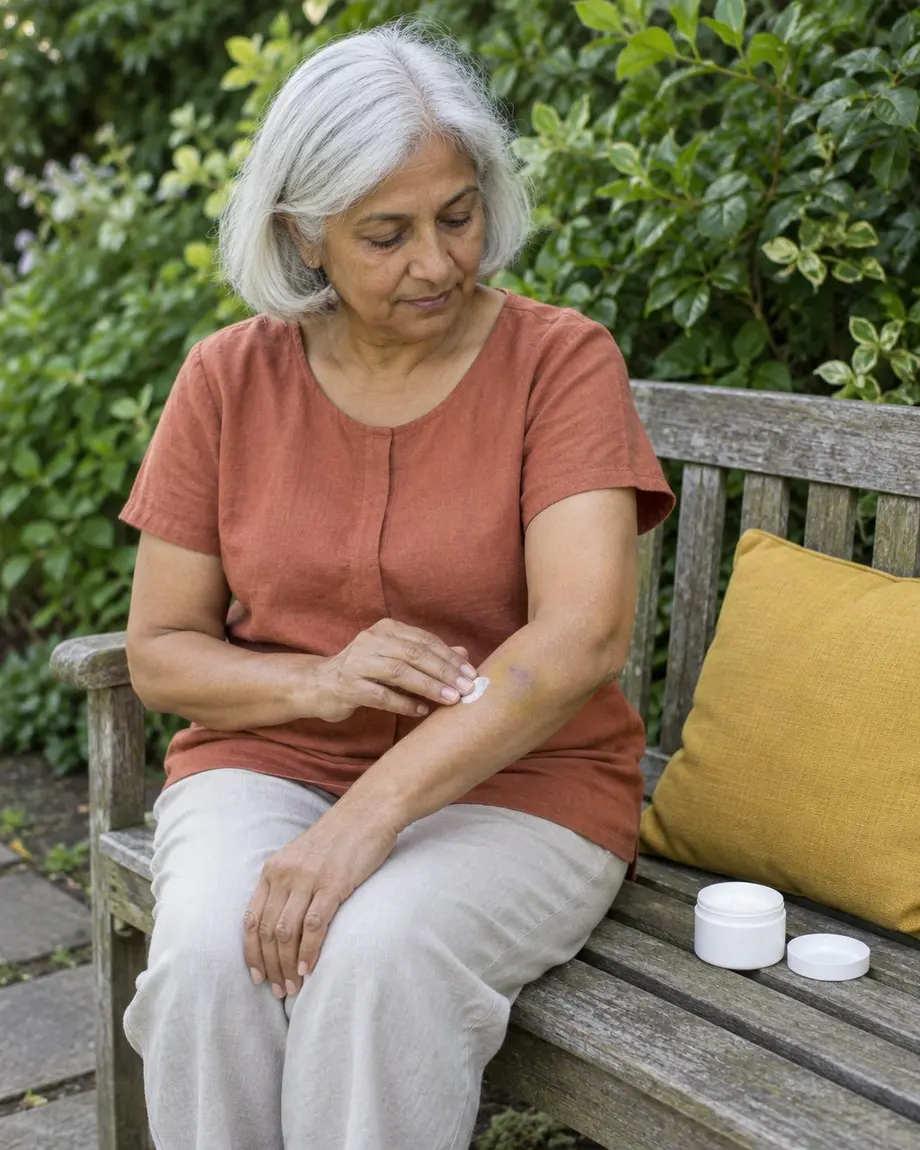
- The American Academy of Dermatology says skin becomes thinner as estrogen levels fall, and thin skin bruises more easily.
- Daily sunscreen cannot thicken skin, but the AAD says it can prevent further thinning.
- A retinoid can help some people if you start slowly. Hormone therapy is a conversation with a clinician, not a skincare step.
- Steroid creams used for a long time, some medicines, and sudden or unexplained bruising are reasons to get checked.
What causes thinning skin after menopause?
Mostly falling estrogen, on top of the sun damage and ageing you already carry. DermNet NZ says estrogen helps maintain skin hydration and produce ceramides, sebum and hyaluronic acid, and lists rapid collagen loss in the first 5 years of menopause. A 2022 dermatology review describes nearly a third of collagen lost in the first 5 years, then a decline of 2.1% per year over the next 15 years.
The wider picture is in how menopause affects your skin, so this page stays on thinning.
Ageing and sun add to it. The German health portal gesund.bund.de says that as skin ages, particularly from UV radiation, the tissue becomes thinner and less elastic. Years of sun exposure are the part you can still slow down.
Why do I bruise so easily?
Thin skin gives the small blood vessels underneath less support. DermNet NZ lists “deficient vascular support, as in aged or sun damaged skin” as a cause of purpura, the purple marks you see after a minor knock. On menopausal skin, DermNet says bruising is common on the arms and lower legs after even minor trauma, and may be compounded by long-term sun damage.
Gesund.bund.de reports that around 12% of people develop this kind of bruising after age 50, and up to 30% after age 75 (source). It says being careful during personal care can help prevent it, along with long clothing and a high-protection sunscreen.
The Merck Manual says easy bruising is common in older adults and rarely a cause for concern if you feel well. It also notes that older adults are more likely to take medicines such as aspirin, clopidogrel, warfarin or direct oral anticoagulants, and that these can sometimes lower clotting too much and cause bleeding or bruising. Do not stop a prescribed medicine on your own. Ask the prescriber.
Is thin skin normal, or something to get checked?
Gradual thinning with dryness, easy bruising on the arms and slower healing fits the menopause pattern. Get it checked when it does not fit:
- Steroid cream. DermNet lists skin thinning, easy bruising and tearing of the skin as local side effects of potent topical steroids used daily over months. It says absorption is greatest through the thin skin of the eyelids and skin creases, where a potent steroid is best avoided. The NHS says hydrocortisone should not be used on the skin for more than 7 days unless a pharmacist or doctor says so, and lists thinning of the skin as a possible side effect.
- Medicines. Blood thinners and aspirin can raise bruising (see above). Tell your doctor about new bruising rather than guessing.
- Bruising that is sudden, widespread or comes with other bleeding. The Merck Manual says people with warning signs should see a doctor right away, and people who notice they bleed or bruise easily should call their doctor.
- Skin that tears or heals slowly. This can be age and menopause, but mention it at your next visit.
What helps thinning skin?
You cannot rebuild lost collagen with a cream, but you can protect what you have and support the skin barrier.
- Daily sunscreen. The AAD recommends a broad-spectrum sunscreen with SPF 30 or higher every day. It says this cannot thicken your skin, but can prevent further thinning. See our sunscreens for dry, menopausal skin.
- Moisturizer. The AAD suggests moisturizer after bathing and through the day when skin feels dry, and says one with hyaluronic acid or glycerin can be especially helpful. Start with moisturizers for menopausal dry skin for the face and body lotions for menopause skin for the rest.
- A retinoid, introduced slowly. The AAD says that for some people, a retinoid cream can help. Details below.
- Protect fragile areas. Cover your forearms in strong sun, pad sharp furniture edges and pat skin dry gently. These are everyday precautions, not treatments.
Do topical retinoids help thin skin, and does retinol thin the skin?
Retinoids do not thin skin in the research. The evidence points the other way, although it is mostly about prescription tretinoin in sun-damaged skin.
A 2025 meta-analysis of tretinoin trials found it consistently thickened the epidermis (the top layer) on skin biopsies, and improved fine and coarse wrinkles compared with a plain base cream. One study reported higher procollagen levels. The authors add that most trials lacked long-term follow-up, and that irritation such as dryness, redness, peeling, burning and stinging was common in the first weeks. DermNet NZ says improvement may take 12 weeks or longer, and that adapalene is the least irritating topical retinoid and tretinoin the most.
The AAD says retinoids speed up turnover of surface skin cells and boost collagen. The peeling many people notice early on is irritation, not thinning.
To start, the AAD advises choosing the least intense formula, using it every other night to start, building up slowly, and using it at night with daily sun protection. Retinoids should not be used during pregnancy. If your skin stings, read retinol irritation on menopausal skin. Our night routine for menopause shows where it fits.
The trial evidence above is for prescription tretinoin, not the retinol sold over the counter. Ask a clinician before using a retinoid on broken skin or skin that is being treated with a steroid.
What about thin skin under the eyes, on the face, hands and arms?
Under the eyes. Eyelid skin is thin, and DermNet notes steroid absorption is greatest there, so avoid steroid creams on the eyelids unless a doctor tells you to use one. A gentle moisturizer, sunscreen and sunglasses are a safe base. For dark circles and fine lines, see eye creams for wrinkles and dark circles.
On the face. The same basics apply. Our guide to estriol face cream explains where topical estrogen fits and why it needs a clinician.
On the hands and arms. Arms are where DermNet places common bruising on menopausal skin, and hands and arms get the most daily sun. Moisturize after washing, put sunscreen on the backs of your hands, and read lotions for crepey skin on arms and legs.
Can thinning skin be reversed? What about hormone therapy and collagen supplements?
Partly, and not by skincare alone.
Hormone therapy. The 2022 review says estrogen HRT has been shown to raise dermal collagen to premenopausal levels, with increases in collagen and skin thickness seen as early as 3 months after starting. It also says studies on HRT efficacy are conflicting, and that more research on topical estrogen for facial skin is needed. DermNet says menopausal hormone therapy may offer improvement to the effects of menopause on the skin. HRT is not prescribed for skin alone. If you are thinking about it for other symptoms, ask a clinician about the benefits and risks for you.
Collagen supplements. A meta-analysis of oral collagen concluded that hydrolyzed collagen supplements can improve skin hydration and elasticity, with longer use giving better results. The authors note the studies varied, some had fewer than 40 people, and larger trials are needed. It does not show that supplements restore thickness.
Peptides and other products. See do peptides work on mature skin and how to reduce signs of aging in menopause.
When should I see a doctor?
See a GP, pharmacist or dermatologist if:
- you bruise with no knock, or bruises are large, widespread or on your trunk or face;
- you take a blood thinner, aspirin or a steroid and notice new bruising or thinner skin;
- you have used a steroid cream on your face, eyelids or skin folds for more than a few days;
- skin tears easily, heals slowly, or a wound becomes red, warm or painful;
- thinning is patchy, on one side only, or comes with a rash or itch that does not settle.
The Merck Manual says people who feel unwell or have risk factors should be seen within a day or two.
Get urgent help if you hit your head while taking a medicine that thins your blood. The NHS says to get help from NHS 111 in that case. In the US, call your doctor the same day or go to urgent care. For bleeding that will not stop with firm pressure, call 911 (US), 999 (UK) or your local emergency number.
Questions you may still have
Does thin skin grow back? Not on its own. Sun protection and moisturizer keep what you have, and a retinoid or hormone therapy may help some people. Any change takes months.
Is thin skin the same as crepey skin? They overlap. Crepey skin is the crinkled, paper-like look that often goes with thinner, drier skin on the arms, legs and neck.
Can I use a retinoid and a steroid cream together? Ask a clinician first. Both can irritate, and potent steroids can thin skin.
Should I take collagen? It may modestly help hydration and elasticity. It does not replace sunscreen and moisturizer.
This is general information, not medical advice or a diagnosis.