
A clear comparison
Skincare comparisons for menopausal skin: which one you need
At a glance
When your skin turns drier or touchier in menopause, the drugstore shelf offers a dozen near-identical jars. Each comparison below puts two real products side by side, using the maker’s ingredient lists, so you can pick the one fact that matters to you. Start with the job you need done, then open the head-to-head that matches.
One idea runs through nearly all of them: if your current product keeps your skin comfortable, switching may add little. Use these pages when something is actually not working, or when you have a reason to avoid an ingredient.
On this page
Which brand line fits your skin
| Brand line | What our comparisons found | Compare here |
|---|---|---|
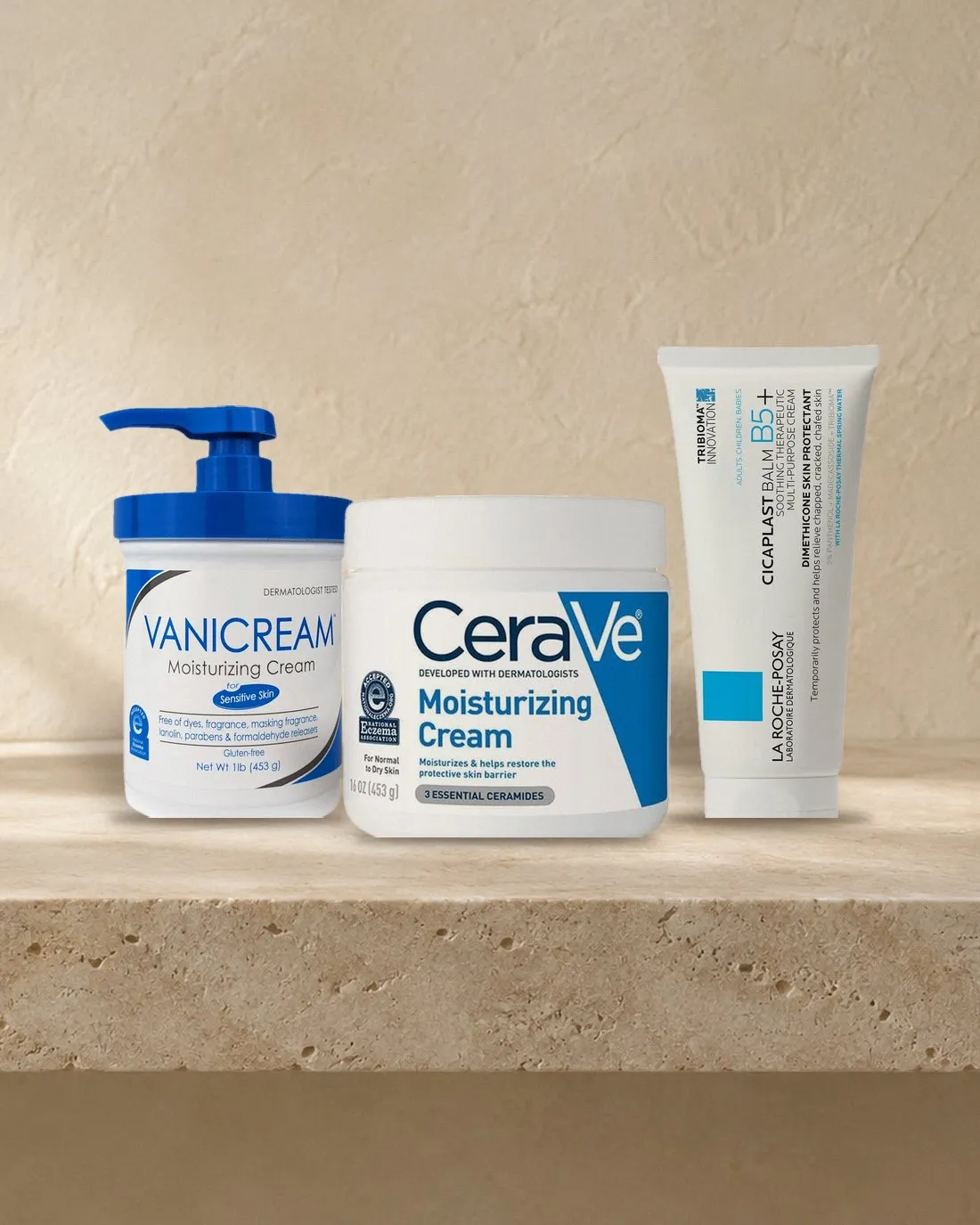
| CeraVe | Moisturizing Cream is fragrance-free with ceramides and sodium hyaluronate; Intensive is a separate richer cream | CeraVe versus Vanicream |
| Vanicream | A shorter formula without botanical extracts or essential oils; no niacinamide | Cetaphil versus Vanicream |
| Cetaphil | Moisturizing Cream lists niacinamide, panthenol and plant oils, including sweet almond oil | CeraVe versus Cetaphil |
| La Roche-Posay | Double Repair is the lighter face cream and lists niacinamide; Dermallergo does not; Cicaplast is a small-patch balm | Dermallergo versus Double Repair |
| Aquaphor and Vaseline | Aquaphor lists lanolin alcohol; Vaseline Lip Therapy and Original Jelly are different products | Aquaphor versus CeraVe ointment |
| Eucerin | Advanced Repair and Intensive Repair both list lactic acid | Eucerin lotions |
| Avène | Tolérance Control is the lightweight daily face cream; Cicalfate+ is the richer protective one | Avène Tolérance versus Cicalfate+ |
Moisturizers and creams
Most of these pages end the same way: choose by what the formula contains and what you avoid, not by a menopause label. CeraVe and Vanicream differ mainly in ceramides and botanicals; the La Roche-Posay pairs differ in niacinamide and richness, and the Avène pair differs in richness.
- CeraVe versus Vanicream Moisturizing Cream: ceramides and sodium hyaluronate, or a shorter list without botanicals.
- CeraVe versus Cetaphil Moisturizing Cream: the page flags sweet almond oil in Cetaphil for nut allergy.
- Cetaphil versus Vanicream Moisturizing Cream: niacinamide and plant oils against none of either.
- CeraVe Intensive versus Moisturizing Cream: Intensive adds shea butter and a Hydro-Urea blend for very dry, flaky skin.
- CeraVe cream versus lotion: the cream has petrolatum for very dry skin; the lotion is lighter and oil-free.
- Vanicream lotion versus cream: nearly the same short formula in two weights.
- Aquaphor versus Vaseline: Vaseline is petrolatum alone; Aquaphor adds glycerin, panthenol and lanolin alcohol.
- CeraVe versus Cetaphil lotion: ceramides and hyaluronic acid, or niacinamide, panthenol and plant oils.
- CeraVe cream versus Eucerin Advanced Repair Cream: a plain protective cream, or 5% urea and lactic acid for rough body skin.
- Vanicream versus La Roche-Posay: a 10-ingredient cream, or shea butter with niacinamide and a ceramide.
- Bag Balm versus Aquaphor: two petrolatum ointments with lanolin; Aquaphor adds glycerin and panthenol.
- Neutrogena Hydro Boost Water Gel versus Gel Cream: the Water Gel is scented; the Gel Cream is fragrance-free.
- Olay versus Dove body wash: Dove Deep Moisture is sulfate-free; both contain fragrance.
- Toleriane Dermallergo versus Double Repair: the pair to read if you avoid niacinamide.
- La Roche-Posay Double versus Triple Repair: lightweight face cream against a richer face-and-body one; Triple is not a stronger anti-aging treatment.
- Avène Tolérance Control versus Cicalfate+: lightweight daily cream or richer protective cream.
- Aveeno Oat Gel versus Vanicream Daily Facial Moisturizer: choose Vanicream if avoiding botanical extracts is your priority.
- Clinique Dramatically Different: Lotion+, Gel or Cream: the Lotion+ is the everyday choice, the Cream the step up, the Gel for oily skin.
- Aveeno Skin Relief versus Daily Moisturizing Lotion: body lotions; the 48-hour and 72-hour claims do not prove you reapply less.
- Eucerin Advanced Repair versus Intensive Repair Lotion: both lists contain lactic acid.
For picks rather than head-to-heads, see our moisturizers for menopausal dry skin and our face creams for menopause.
Ointments and rescue balms
These are for a dry, chapped or chafed patch, not an all-over cream. The pages agree that you do not need both a balm and an ointment because skin is drier in menopause.
- Aquaphor versus CeraVe Healing Ointment: start with CeraVe if you were told to avoid lanolin; Aquaphor lists lanolin alcohol.
- CeraVe Healing Ointment versus Moisturizing Cream: ointment for selected dry areas, cream for an ordinary moisturizing step.
- Lipikar versus Cicaplast: Lipikar for larger dry areas, Cicaplast for a small patch.
- Avène Cicalfate+ versus Cicaplast B5+: panthenol and a skin-protectant label, or a mineral-oil and zinc-oxide formula.
Cleansers
If your face feels tight after washing, the cleanser may matter as much as the cream. These pages compare exact bottles; none finds a universal winner.
- CeraVe versus Cetaphil cleanser: ceramides in the wash, or the shortest list with a no-water option.
- Toleriane Hydrating Gentle versus CeraVe Hydrating Cleanser: the CeraVe list has no niacinamide; the La Roche-Posay one does.
- Cetaphil Gentle versus Daily Facial Cleanser: cream-style wash or gel-to-foam.
- CeraVe Foaming Oil versus Hydrating Facial Cleanser: an oil-to-foam rinse-off or the non-foaming cream wash.
- CeraVe Foaming versus Hydrating Facial Cleanser: the foaming wash against the cream one.
- Vanicream Body Wash versus Dove Sensitive: choose Vanicream when avoiding added fragrance is the requirement.
Night creams
- CeraVe PM versus Skin Renewing Night Cream: an evening lotion, or a cream with shea butter and peptides; neither is an essential menopause purchase.
- Does menopausal dry skin need a separate night cream?: no, not automatically; use your day/night moisturizer in the evening if it keeps you comfortable.
SPF lotions
- CeraVe AM versus Ultra-Light SPF 30: AM for a normal-to-dry routine, Ultra-Light for normal-to-oily. For swimming or heavy sweating, pick a sunscreen with an explicit water-resistance label.
See also sunscreens for dry menopausal skin.
Serums
- The Ordinary Marine Hyaluronics versus Hyaluronic Acid: one is an exceptionally light layer; the other adds panthenol and barrier ingredients. If a moisturizer already keeps your face comfortable, skip both.
Lips
- Vaseline Lip Therapy versus Original Healing Jelly: the lip label does not make it better; the Mini jar and the Stick are different products.
Do I need it at all?
- Menopause skincare versus regular skincare: pay for a formula you tolerate or an easier routine, not for a menopause label.
- Does menopausal dry skin need a separate night cream?: only when it fills a real gap.
Persistent dryness, burning, itch or rash needs a clinician, whatever you buy. The sudden sensitivity guide is a good first read.
For general care, the AAD guidance for skin care during menopause supports gentle cleansing and moisturizing.
Comparison summaries checked November 9, 2026. Formulas change and differ by country, so read the label on your package.