
Practical guide
Menopause skin rash, red patches or burning: when to worry
At a glance
Quick answer: Menopause is linked to dry, itchy, more sensitive skin and to hot flushes that redden the face, neck and chest. It is not a proven cause of a true rash, and a rash that appears around menopause often has another cause, such as irritation, eczema, rosacea, hives or shingles. A burning feeling can also have several causes. Keep your routine gentle and simple, and see a clinician if a rash is new, painful, blistered, spreading, lasts more than a few days or keeps coming back.
Flushing is temporary redness and warmth that happens when blood vessels in the skin widen, and it is different from a rash.
On this page
Key points
- The NHS lists skin changes, including dry and itchy skin, and hot flushes among menopause symptoms. Its list does not include a rash (NHS).
- Hot flushes can make the face, neck and chest suddenly feel very hot (NHS). Flushing can also trigger or worsen rosacea (review).
- Rash, red patches or burning can come from conditions that menopause does not cause, and some need treatment. Do not assume hormones are the reason.
- Some signs, such as breathing trouble or swelling of the lips, need urgent help (see below).
Can menopause cause a skin rash?
Not directly. The NHS names “skin changes, including dry and itchy skin” as a menopause symptom. It does not list a rash.
What the evidence does support is a more vulnerable skin barrier. The American Academy of Dermatology says skin can hold water less well after menopause and may become more sensitive and prone to irritation. A 2022 dermatology review lists itch, dry skin (xerosis) and eczema among the skin problems reported by menopausal women.
So a rash in midlife is often dry or irritated skin reacting to something, or a skin condition that happens to appear at this age. In German this is often searched as Hautausschlag in den Wechseljahren, and the same advice applies.
Why do I get red patches on my face and neck?
Two common reasons:
- Flushing. Hot flushes happen when the face, neck and chest suddenly feel very hot, and they can come with sweating (NHS). The same dermatology review says flushing affects around 75% of perimenopausal and menopausal women and is thought to come from widening of blood vessels in the skin (review). Flushing comes and goes. It is not a rash.
- Rosacea. The NHS describes rosacea as a long-term condition with redness that comes and goes across the nose, cheeks, forehead, chin, neck and chest, sometimes with warmth, pain, or burning and stinging when using water or skincare products. DermNet NZ says rosacea may be made worse by menopausal flushing, and the review above says flushing is known to worsen or even bring on rosacea.
If redness keeps coming back in the same places, lasts longer than a flush, or comes with bumps, visible small blood vessels or stinging, get it looked at. The NHS says rosacea cannot be cured, but treatment from a GP can help control it. It adds that redness may be harder to see on brown or black skin, so notice warmth, tightness and texture as well as colour.
Why does my skin burn?
Be careful here. The NHS lists a burning feeling in menopause only for the vagina and the urinary tract. It does not list burning skin on the face or body as a menopause symptom.
Some tingling and odd sensations do appear in the menopause literature. A 2014 review in the Journal of Mid-Life Health describes postmenopausal skin with a feeling of intense tingling and formication (a crawling feeling), linked to estrogen and the skin’s nerve supply. The Cleveland Clinic says changes in estrogen can cause pins-and-needles feelings in the hands, feet, arms and legs that usually pass quickly. For itch and the crawling feeling, see why menopause makes skin itch.
Burning can also come from other things:
- Irritated skin. The NHS says irritants such as soaps, detergents and regular contact with water are the most common cause of contact dermatitis.
- Rosacea. Burning or stinging when using water or skincare (NHS).
- Hives. The rash can itch, sting or burn (NHS).
- Shingles. It can start with a tingling or painful feeling in an area of skin before a rash appears (NHS).
- Vaginal burning. The NHS lists dryness, burning, irritation or itching in and around the vagina as a menopause symptom. A GP can advise on it. Do not treat it with face or body skincare.
A new, one-sided or very painful burning feeling, especially with a rash or blisters, should be checked quickly.
What looks like a menopause rash but is not?
You cannot reliably tell these apart by looking, and the NHS says not to try to diagnose itchy skin yourself. Use this as a guide to what to mention to a clinician, not as a diagnosis.
Contact dermatitis (a reaction to something touching the skin). The NHS says it makes skin itchy, blistered, dry and cracked, usually within hours or days of contact, most often on the hands and face. Irritants are the most common cause. Allergic contact dermatitis is less common and can be triggered by substances in products such as cosmetics, or by some metals.
Eczema. The NHS describes periods of flare-ups and better times. DermNet NZ describes asteatotic eczema, with dryness, redness and scaling, as the end result of increased skin dryness in postmenopausal skin.
Rosacea. See above. The NHS notes it can look like acne, dermatitis or lupus, which is one more reason to have a persistent red face examined.
Hives (urticaria; in German, Nesselsucht). The NHS describes raised bumps or patches in many shapes and sizes that itch, sting or burn and can appear anywhere. Triggers include foods, plants, chemicals, heat, sweating, stress, medicines, infections, and scratching or pressure on the skin. Menopause is not listed among the established causes, so have hives that keep coming back looked at.
Shingles. An infection that causes a painful rash on one side of the body, with blotches that become itchy, oozing blisters. A rash on both the left and right is unlikely to be shingles (NHS). Treatment works best when started early, so do not wait.
What can help first?
Start with the least you can do. For itchy, irritated skin the NHS suggests:
- Use an unperfumed moisturizer or emollient regularly.
- Take cool or lukewarm showers or baths, and do not stay in long.
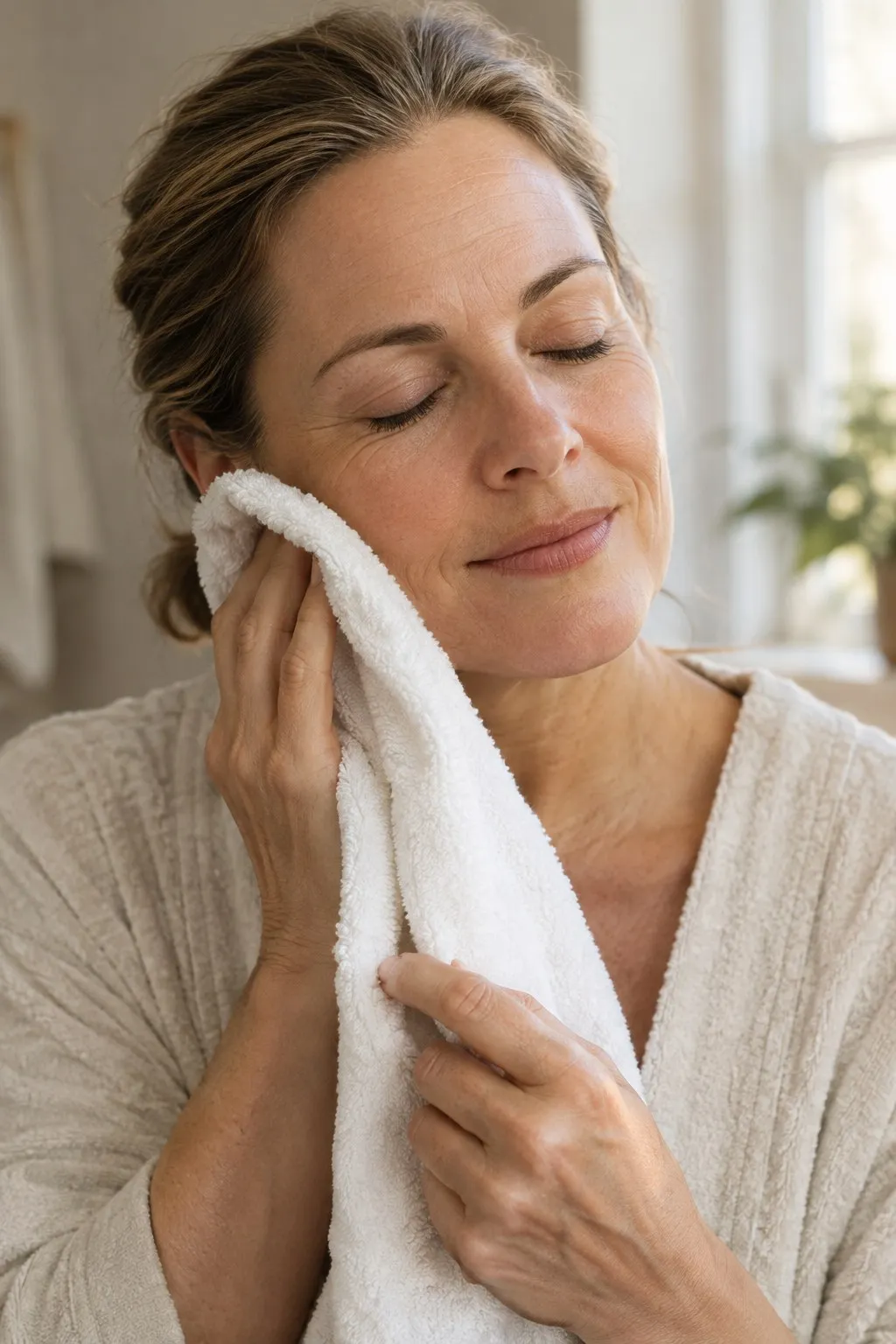
- Hold something cool, such as a damp towel, on the area. Pat or tap instead of scratching.
- Avoid perfumed soaps, deodorants and moisturizers.
- Wear loose cotton or silk, and avoid tight clothes and wool or synthetic fabrics.
- Use laundry products made for sensitive skin.
If contact dermatitis is possible, the NHS says the best way to help is to avoid the irritant or allergen: rinse the skin with warm water and an emollient, check the ingredients of make-up and soap, and use emollient soap substitutes instead of regular soap.
If you are not sure what to simplify first, read menopausal skin that has suddenly become sensitive. For fragrance in particular, see fragrance-free and unscented products. For itch, see what to try for itchy skin around menopause.
A pharmacist can help with itchy skin and advise on hives. For shingles, the NHS says a pharmacist can give the same antiviral medicines as a GP.
When should I see a doctor?
See a GP or pharmacist, depending on how it looks and feels, if:
- the rash is new, painful, blistered, spreading or does not improve with gentle care. The NHS says to see a GP for contact dermatitis that is persistent, recurrent or severe;
- itch is all over your body, severe or keeps coming back, or comes from a new rash, lump or swelling you are worried about (NHS);
- hives do not improve after 2 days, keep coming back, or spread (NHS);
- you have symptoms of rosacea (NHS);
- you have a tingling or painful patch of skin, with or without a rash, and think it could be shingles. The NHS says to get advice quickly from a pharmacist or doctor (NHS 111 in the UK), ideally within 3 days of the rash appearing;
- burning, itching or dryness is in or around the vagina (NHS).
Itchy skin is not usually a sign of anything serious, but less commonly it can point to thyroid, liver or kidney problems, which is why persistent or whole-body symptoms deserve a check (NHS).
When is it urgent?
These thresholds come from the NHS (UK). In the US, call 911; elsewhere, use your local emergency number.
Call 911 (US), 999 (UK) or your local emergency number for signs of a serious allergic reaction, listed by the NHS:
- sudden swelling of the lips, mouth, throat or tongue;
- fast breathing or struggling to breathe;
- a tight throat or trouble swallowing;
- blue, grey or pale skin, tongue or lips;
- sudden confusion, drowsiness or dizziness, or fainting.
You may also have a swollen, raised or itchy rash. See the NHS on anaphylaxis.
Get an urgent appointment with your doctor (in the UK, a GP or NHS 111) if:
- you have symptoms of shingles and the rash is on your eye or nose, or your vision changes (NHS);
- you have rosacea and your eye is painful, red or gritty, you are sensitive to light or your vision is blurred (NHS);
- hives come with a high temperature and feeling unwell, or with swelling under the skin (NHS);
- you have eczema that is blistered, crusty, leaking fluid, painful, swollen or warm, or you have a high temperature or feel generally unwell (NHS).
Questions you may still have
Is a rash a sign of perimenopause? It can appear at the same time, but the NHS list of menopause symptoms does not include a rash in itself. Dry, itchy, sensitive skin is. If a rash appears, look for a trigger and get it checked if it persists.
Is burning skin at night normal in menopause? Night sweats and hot flushes can make you feel very hot (NHS). A burning feeling that stays, sits in one patch, or comes with a rash should not be put down to menopause without a check.
Will HRT stop it? Hormone therapy is a medical decision. The review above says flushing generally responds to estrogen therapy, but it does not show that HRT treats rashes. Talk to a clinician about your own benefits and risks.
Should I try more products? If perfumed products might be part of it, the NHS says to avoid perfumed soaps, deodorants and moisturizers. Simplify first, and ask a pharmacist or GP if it does not settle.
Sources checked October 13, 2026: NHS (menopause symptoms; itchy skin; contact dermatitis; atopic eczema; rosacea; hives; shingles; anaphylaxis), DermNet NZ (menopause and the skin), American Academy of Dermatology (skin care during menopause), Kamp et al., Clinical and Experimental Dermatology 2022 (full text), Nair, Journal of Mid-Life Health 2014, and Cleveland Clinic (weird symptoms of low estrogen). This is general information, not medical advice or a diagnosis.