
Researched review
EVER Quench Advanced Hydrating Booster review for dry, easily irritated menopausal skin
At a glance
EVER Quench Advanced Hydrating Booster is a watery hyaluronic acid and glycerin serum with no fragrance and no essential oils on its ingredient list. It is the one EVER product we would look at first if your skin is dry and reacts easily. It is a hydrating layer, not a moisturizer: the brand itself says to follow it with a cream or SPF, and it does not act on hormones. The brand sells its range for perimenopause and menopause, but nothing on the Quench page shows it works differently on menopausal skin.
On this page
The answer in one table
| Question | Short answer |
|---|---|
| Made for menopause? | Marketed that way, not shown. EVER says its range addresses “hormonal skin changes.” The Quench page gives no menopause-specific study. |
| What is it? | A lightweight hydrating serum with two forms of hyaluronic acid, glycerin, ectoin, allantoin, aloe and fruit extracts. |
| Fragrance? | The brand lists the aroma as “Aroma Free.” No fragrance, essential oil or alcohol appears on the list. |
| Replaces a moisturizer? | No. The brand says to follow it with a moisturizer and/or SPF. |
| Best for | Dry, tight or dehydrated skin that dislikes scented products, layered under a cream. |
| Skip it if | You want one product to do everything, or you have reacted to plant or algae extracts. |
Is EVER really made for menopause?
EVER Skincare is a US brand whose home page describes it as formulated “to address hormonal skin changes in women.” Its About page says the brand “was built just for” women going through perimenopause and menopause. Its LSR10 page says the patented LSR10 complex of magnolia bark extract, ectoin and ergothioneine is “formulated to address the hormonally-accelerated skin changes women experience as we age.”
How far that goes:
- A real positioning, not a medical category. The medical advisory page names an OB-GYN, a family physician with menopause certification and a dermatologist as advisors, and says its claims are reviewed by them. That is the brand’s statement. It does not tell you what each advisor reviewed.
- Nothing in the formula acts on hormones. The Quench list contains no hormone, phytoestrogen or prescription ingredient, and the brand does not claim one.
- LSR10 is not in Quench. The “clinically proven to reduce the top 10 signs of aging” line belongs to LSR10 products. The Quench list has ectoin, one of LSR10’s three ingredients, but not magnolia bark or ergothioneine. The Quench page does not claim LSR10.
- “Menopause skincare” is a range label. The American Academy of Dermatology describes the skin changes themselves: skin loses some ability to hold water in menopause and can get quite dry. Its advice is moisturizer after bathing and through the day, with hyaluronic acid or glycerin called especially helpful, and a fragrance-free moisturizer for skin that is easily irritated. A brand name for perimenopause does not add to that advice.
Our reviews of No7 Menopause Instant Radiance Serum and Caire Beauty make the same point for other menopause-marketed ranges.
What the official ingredient list shows
EVER’s Quench product page, checked October 21, 2026, lists a 1 fl oz airless bottle (the pack shot reads 30 ML / 1 FL. OZ.) and this ingredient list:
Aqua, Propanediol, Glycerin, Ectoin, Allantoin, Hydrolyzed Hyaluronic Acid, Aloe Barbadensis Leaf Extract, Anisifolia Concina Extract, Sodium Hyaluronate, Phytic Acid, Citrullus Lanatus (Watermelon) Fruit Extract, Pyrus Malus (Apple) Fruit Extract, Lens Esculenta (Lentil) Fruit Extract, Sodium PCA, Sodium Lactate, Glyceril Glucoside, Glycogen, Phenoxyethanol, Xanthan Gum, Ethylhexylglycerin, Acacia Senegal Gum.
What that means:
- Hyaluronic acid, two forms. Hydrolyzed hyaluronic acid and sodium hyaluronate are both listed, which fits the brand’s “dual-weight” description. The amounts are not published. A 2012 review describes hyaluronic acid as a key molecule in skin moisture because it retains water. A 2011 trial of 76 women aged 30 to 60 found that 0.1% hyaluronan creams of several molecular weights improved hydration and elasticity around the eyes compared with a vehicle cream. It tested creams, not a serum, and EVER does not say how much hyaluronic acid Quench contains.
- Glycerin. Third on the list, after water and propanediol. The AAD names glycerin among the ingredients to look for in a dry-skin product.
- The rest of the water-side ingredients. The brand says aloe reduces dehydration while calming irritated skin. Allantoin, ectoin, sodium PCA, sodium lactate and glyceryl glucoside are listed too; the page does not say what each does here, and no amounts are published.
- Plant extracts. Aloe, watermelon, apple and lentil extracts are listed, plus anisifolia concina (the brand’s copy refers to a red algae extract). They are not zero-risk for everyone.
- No scent, no oils, no alcohol, no silicones on the list. The brand also lists “Aroma Free” in its product details. The AAD advises dry, sensitive skin to choose products labeled “fragrance-free” and says “unscented” products can contain masking chemicals; EVER’s wording is “Aroma Free,” not “fragrance-free,” so confirm on your own bottle.
- Preservatives. Phenoxyethanol and ethylhexylglycerin.
- No oils, butters or waxes. That is why it is a water layer rather than a cream.
What the brand claims, and how far it goes
The Quench page says the serum hydrates within 15 minutes and “increases skin water content by 2x in 2 weeks with measured improvement in skin barrier protection.” It also reports that 100% saw significant improvement in skin texture, 100% in deep lines and wrinkles, and 97% said skin felt immediately softer. The footnote reads: “Based on a 4-week clinical study of 30 participants, aged 36-65 and clinical studies conducted on Acquacell at levels up to 3%.”
- Thirty people is a small study, and it is the brand’s. The page gives no control group, method or measuring device, and does not say which figure came from which study.
- The age range includes premenopausal women. Thirty-six to 65 spans women who have not started perimenopause. The page does not say how many participants were menopausal.
- The footnote mixes two sources. One is the finished serum; the other is studies on an ingredient (“Acquacell”). Ingredient data does not show what the bottle does.
- “Deep lines and wrinkles” is a large claim for a hydrating serum. Water-plumped skin can look smoother for a while. The page does not show how long, or how lines were measured.
- The section header is broader than the formula. The page titles its results block “Address the hormonal impacts of aging,” but the listed benefits are all about hydration and skin look.
Treat the numbers as the brand’s own and read the product as a hydrating serum.
Is it a good serum for menopausal dry, easily irritated skin?
The NHS says itchy skin is common after menopause and usually gets better over time, advises an unperfumed moisturiser or emollient regularly, and says not to use perfumed moisturisers. The AAD says a cream or ointment is more effective for dry skin than a lotion, and to apply it while skin is still damp after bathing.
Against that standard:
- It fits because it has no fragrance or essential oils and a short list of water-binding ingredients.
- It does not complete the job because it has no oils or butters to soften and seal. The AAD’s advice is built around a cream. If you could only buy one thing, buy a fragrance-free cream first; our fragrance-free moisturizers for menopausal dry skin shows options.
- It is optional. A moisturizer that already contains hyaluronic acid or glycerin covers the AAD’s advice. Quench is for someone who wants a lighter first layer under a cream, perhaps in a dry climate or a heated house.
For where a serum sits in a short routine, see do you need a serum in menopause and a simple menopause skincare routine.
Which other EVER products fit, and which to skip
EVER’s own pages show how unusual Quench is in its range. We read the official ingredient lists of the products most likely to tempt a menopausal reader.
| EVER product | What it is | Scent or irritant notes from the official list |
|---|---|---|
| Quench Advanced Hydrating Booster | Hydrating serum | “Aroma Free.” No essential oils or alcohol listed. |
| Hydralift Rich Moisture Injection Cream | Rich cream for dry skin | Aroma “Light,” “All-Natural Magnolia.” Lists chamomile, jasmine, lavender, marjoram, vanilla, sandalwood and ylang-ylang oils. |
| Hydralift Moisture Injection Cream | Medium cream | Aroma “Light.” Lists geranium, lemon peel, spearmint and cedarwood oils, plus a vitamin C derivative. |
| Daylight Radiance Tinted Moisturizer SPF 32 | Tinted mineral SPF | Zinc oxide 6% and titanium dioxide 4.5%. Lists citrus, geranium, lime and other oils, citral, benzyl acetate and “Alcohol.” |
| Refresh Soft Foaming Cleanser | Foaming cleanser with glycolic acid | Lists the same citrus and floral oils. Glycolic acid is an exfoliating acid. |
DermNet notes that fragrances can be natural extracts or synthetic, and that fragrance allergy is second only to nickel allergy as a cause of allergic contact dermatitis. “All-natural” does not mean a plant oil cannot irritate. If your skin is currently itchy, burning or red, the cream, the SPF and the cleanser are the products to patch test with care or avoid, and Quench is the one to start with. The daily sunscreen step still matters: the AAD advises a broad-spectrum SPF 30 or higher daily, and our sunscreens for dry skin in menopause lists alternatives.
Quench downsides and who should skip it
- It is not a moisturizer. On very dry skin it can feel like not enough on its own.
- It adds a step and a cost. Compare the current price per ounce with a hyaluronic acid serum you already own or a fragrance-free cream.
- The evidence is the brand’s. There is no independent trial of this serum, and none on menopausal skin.
- Plant extracts. Skip it if you have reacted to aloe, fruit or algae extracts.
- Not made for a rash or itch. A serum will not treat eczema, rosacea or an infection. The NHS says to see a GP if itchy skin affects your daily life, does not get better with self care or keeps coming back, is caused by a new rash, lump or swelling you are worried about, is all over your body, is severe, or happens during pregnancy.
- The brand’s menopause label does not make it a better pick than a plain hyaluronic acid serum. If you already own one you like, there is no clear reason to switch.
How to use it more safely
Patch test on the inner arm for a few days, then try it on a small area of the face. The brand’s directions: use after cleansing and toning, before moisturizing, press one dropper onto the face, morning and/or night, and follow with a moisturizer and/or SPF. It suggests extending it to the neck and décolleté. The AAD advises applying moisturizer while skin is still damp after bathing, so follow Quench with your cream rather than leaving it on its own. If you use other serums, the brand says to put Quench on first. Introduce one new product at a time and stop if you get stinging, burning or a rash.
Where to buy Quench
The link goes to the 1 fl oz (30 ml) bottle. Check the ingredient list on the package you receive.
Questions before buying
Is EVER Quench fragrance-free?
The brand lists its aroma as “Aroma Free,” and no fragrance, essential oil or alcohol appears in the ingredient list. The brand does not use the exact phrase “fragrance-free” on the page we checked.
Is EVER Skincare good for menopause?
It is marketed for perimenopause and menopause, and it uses an advisory board of clinicians. Its formulas are conventional cosmetics. Quench is a hydrating serum with no hormonal action.
Do I need a moisturizer with it?
Yes. The brand says to follow it with a moisturizer and/or SPF. It has no oils or waxes on its list.
Does it contain peptides or niacinamide?
Not on the brand’s ingredient list. Check your package.
Can I use Quench with retinol or acids?
The brand says to apply Quench first when layering with other serums. If you use a retinoid or exfoliating acid, introduce one product at a time and ask a clinician if your skin is irritated.
The researched verdict
A short, scent-free hyaluronic acid and glycerin serum from a brand whose menopause positioning is marketing rather than proof. It is the right EVER product for dry skin that reacts to fragrance, and worth a look as a light layer under a cream. It is not necessary, not menopause-specific, and its figures come from a 30-person study the brand ran itself. If you want one step, buy a fragrance-free cream first. If you want to try EVER, choose Quench and be cautious with its scented creams, SPF and cleanser.
Manufacturer ingredient list, directions and claims checked October 21, 2026. Read the ingredient list on your package.
Compare before you buy
Shop the products discussed
Choose a product for the job it fills. Check the selected size, current package ingredients and seller before ordering.
Shopping outside the US? The store may take you to a local site in supported countries. Our product research covers the US formulas. Products, sizes, ingredients and availability can differ by country. Check the local listing before buying.
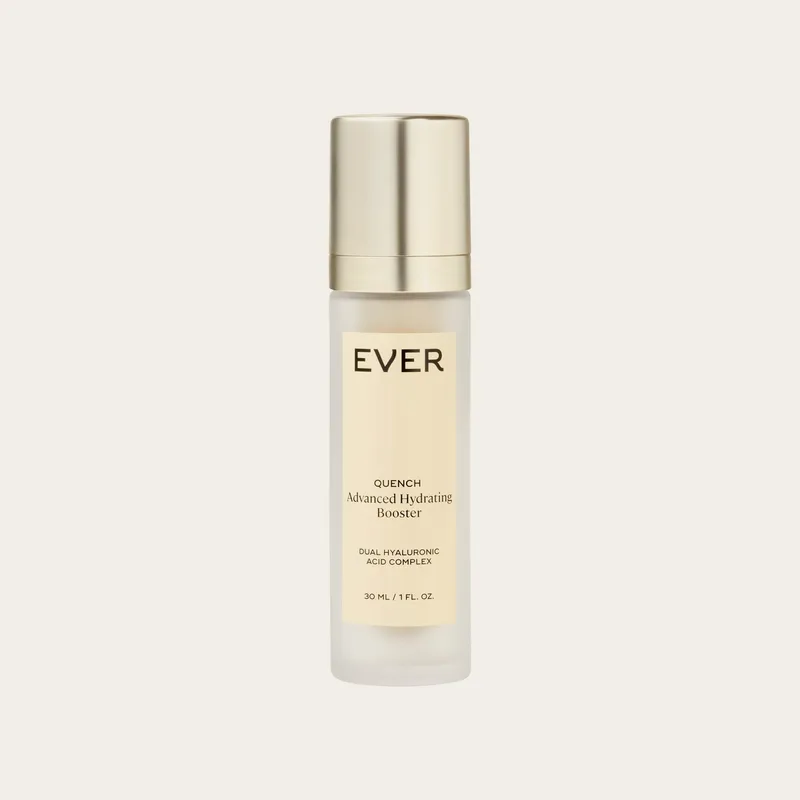
Photo: EVER · Pictured: 1 fl oz / 30 ml bottle
EVER Quench Advanced Hydrating Booster
Linked size: 1 fl oz / 30 ml
Check the ingredient list on the package you receive.
Check priceProduct buttons and linked photos are affiliate links. Stock, sellers and packaging can change. Each card names the linked size.